

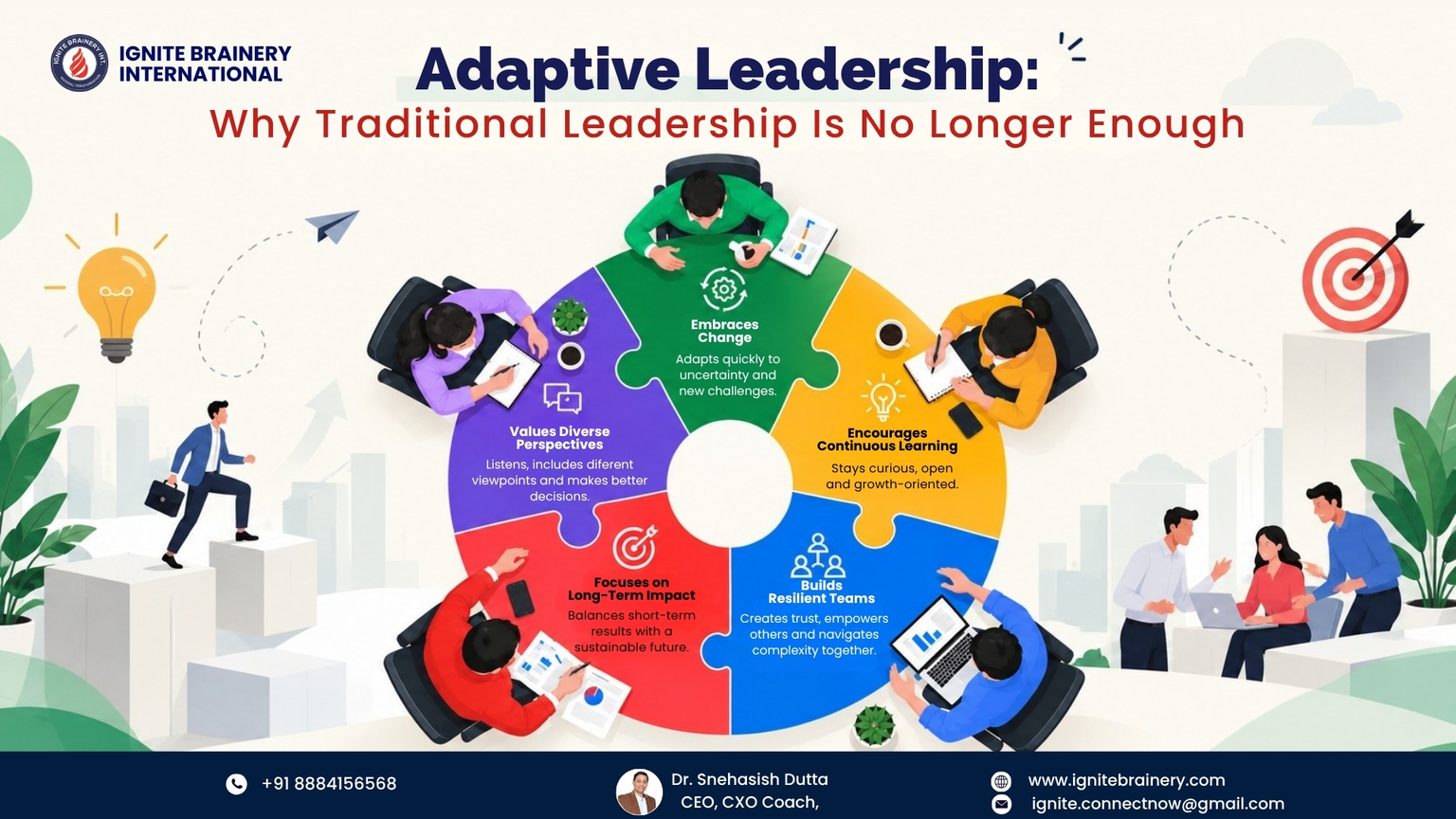
Adaptive Leadership: Why Traditional Leadership Is No Longer Enough
From Dr. Snehasish Dutta
Adaptive leadership involves leading in such a manner that you lead people through difficult situations that don’t have any solutions at all. This form of leadership does not involve giving orders as per the playbook, but you watch changes around you, try out something new and help your people to learn from it.
It works best when markets become unpredictable, your industry gets disrupted by technology, or your people are caught in conflicting worlds.
Why Traditional Leadership Is No Longer Enough
The traditional approach to planning is straightforward. The boss has the answers, and the team implements, for a period of 3 to 5 years.
However, this breaks down the moment the ground shifts.
Consider what Indian leaders have faced in recent times. AI-based applications are reinventing jobs. Hybrid work is now commonplace. Funding cycles have sped up in startups, and customers can alter their requirements within months. The 5-year plan can become redundant within 18 months.
Using an outdated playbook results not only in sluggishness but also solves the wrong problem in the most efficient manner possible.
What Is Adaptive Leadership?
Adaptive leadership is a framework for mobilizing people to face tough challenges and thrive through change. The leader’s job is not to have every answer. It is to help the organization find them.
Technical Problems vs. Adaptive Challenges
This split is the heart of the idea.
| Technical Problem | Adaptive Challenge | |
| Example | Payroll software crashes | Your best talent wants a different way of working |
| Answer exists? | Yes, an expert can fix it | No, it must be discovered |
| Who does the work? | The expert or the leader | Everyone involved |
| Result needed | A repair | A change in behavior or belief |
Most leaders get into trouble by treating adaptive challenges like technical ones. They buy a tool or write a policy, and nothing changes.
What Are the Four Principles of Adaptive Leadership?
Different authors list different principles. A widely taught set is the four below.
- Emotional Intelligence
You listen to yourself and to others. Change breeds fear, and a good leader who acknowledges this fear in a composed manner helps maintain the working of the team. - Organizational Justice
The more people feel that decisions made are fair, the easier it is for them to accept difficult changes. It’s important to explain the “why,” share responsibility, and protect nobody. - Development
You make investments in the development of your people. Organizational adaptation requires that your staff be adaptable and learnable. - Character
Your team is observing how you act in stressful situations. Being honest, humble, and admitting your mistakes creates the trust needed for change.
What Are the Three Steps of Adaptive Leadership?
The Practice of Adaptive Leadership.
- Observe. Step back and look at the situation like a neutral outsider. Leaders call this “getting on the balcony.” What is actually happening, not what you assumed?
- Interpret. Ask what is behind the patterns. Is the resistance about fear, loyalty, loss of status, or something else? Build more than one theory.
- Design interventions. Try small experiments based on your theories. Watch the results, learn, and adjust.
Then repeat. The loop never really ends.
Adaptive Leaders Shine in the Face of Complex Challenges
Complex challenges don’t have a clean fix, and that is where adaptive leaders stand out. Three habits matter most.
Corporate Scenario Planning
Instead of betting on one forecast, they map several possible futures. What if raw material costs double? What if a global competitor enters your market? Corporate scenario planning prepares your team to respond in days, not months.
Strategic Foresight 2050
Foresight is not prediction. It is the habit of scanning for weak signals: demographic shifts, climate pressure, and AI adoption. Leaders who think about strategic foresight toward 2050 make better decisions in 2026, because they spot slow trends early.
Cognitive Diversity Leadership
Teams where everyone thinks alike miss the same blind spots. Cognitive diversity leadership means deliberately bringing different thinking styles, backgrounds, and experiences into the room, then making it safe for people to disagree. For Indian organizations that span regions, languages, and generations, this is a real advantage if you use it.
Psychological Resilience for Executives
Adaptive leadership is tiring. You live with uncertainty, criticism, and decisions you can’t fully verify.
Psychological resilience for executives is not about being tough. It is about recovering well. Practical habits include:
- Separate identity from outcome. A failed experiment is data, not a verdict on you.
- Protect recovery time. Sleep, breaks, and real days off improve judgment.
- Build a peer circle. Talk to people outside your company who face similar pressure.
- Name your stress. Saying “I’m anxious about this launch” reduces its grip.
A resilient leader steadies the room. An exhausted one spreads panic.
Discoveries With Leadership: Learning Out Loud
Here is the mindset shift. Adaptive leaders treat strategy as a series of discoveries with leadership at the center of the learning.
You run a pilot in one city before scaling to ten. You test a new reporting structure for one quarter. You share what worked and what didn’t, openly.
This makes failure cheap and learning fast. It also tells your team that experimenting is safe, which is exactly what you need when no one has the answer yet.
What Are the Pros and Cons of Adaptive Leadership?
Pros
- Handles uncertainty and fast change well
- Builds a more capable, independent team
- Encourages innovation and honest feedback
- Spots problems earlier through broader input
Cons
- Can feel slow when quick, firm decisions are needed
- Creates discomfort, since people lose the comfort of clear instructions
- Needs high trust, which takes time to build
- Poorly done, it looks like indecision.
What Does It Take to Become an Adaptive Leader?
You don’t need a new title. You need new habits. Here is where to start with future-proofing leadership mindsets:
- Get comfortable not knowing. Say “I don’t know yet, let’s find out” without flinching.
- Ask more than you tell. Hold back your opinion in meetings until others speak.
- Run small experiments. Pick one challenge this month and test a new approach.
- Seek out disagreement. Invite the person most likely to challenge you.
- Give the work back. Resist solving every problem yourself. Let your team own it.
- Reflect weekly. Spend 15 minutes asking what you learned and what you’d change.
Structured learning speeds this up. Coaching, peer groups, and leadership programs give you safe spaces to practice before the stakes get high.
FAQs
What is adaptive leadership in simple words?
Adaptive leadership refers to leading individuals during times of change without knowing how to solve the problem. The leader listens, tests and facilitates learning among the group members.
What are the four principles of adaptive leadership?
The most widely recognized ones include emotional intelligence, organizational justice, development, and character. Collectively, these help leaders develop trust and maintain stability amid change.
What are the three steps of adaptive leadership?
The most commonly known ones are Emotional Intelligence, Organizational Justice, Development, and Character. All of these help the leaders in building trust and maintaining stability.
What are the pros and cons of adaptive leadership?
Advantages: Flexibility, improved teamwork, and innovation. Disadvantages: Decision-making is slow, uncomfortable during change process, and requires high level of trust. This approach should be used when dealing with difficult situations, not urgent ones.
Can anyone become an adaptive leader?
Yes. It is a set of skills which are learnable: staying curious, posing questions, testing ideas, and handling pressure. A person does not have to be a senior to practice this.
Conclusion: Lead for What’s Next, Not What Was
The world that your group is part of will continue to evolve. Leaders who depend on one plan will continue to be caught off guard, while leaders who form adaptability habits will continue to learn faster than their environment changes.
Start small. Identify one sticky problem, be honest about it, and conduct one experiment this month.
Ready to build adaptive leadership skills in your team? Explore the leadership programs at Ignite Brainery and take the first step toward leading with confidence in uncertain times.
Contact Us: +91 8884156568
CXO Coach | Founder, Ignite Brainery International