

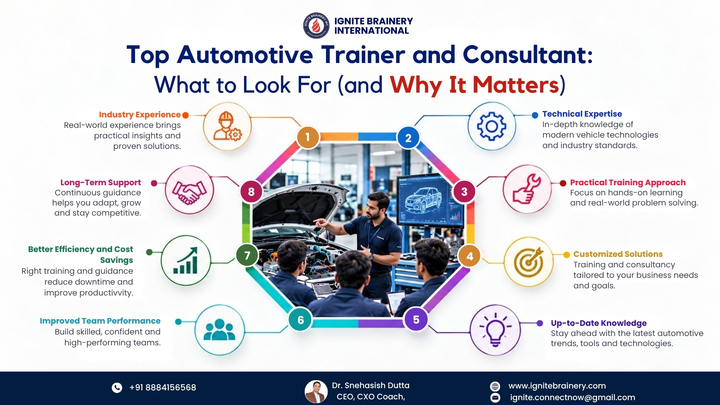
Top Automotive Trainer and Consultant: What to Look For (and Why It Matters)
In today’s world, exploring the right automotive trainer is never as simple as scrolling through a fancy list of certifications. Many people can list years of experience on a resume or a LinkedIn profile and show their popularity. Yet, sitting in a workshop with someone who can actually get a room full of technicians, or a sales floor full of advisors, to retain what they’re teaching? That’s a different skill altogether, and it’s one a surprising number of so-called experts never quite master.
This matters more than most dealerships and service centers realize, usually until something goes wrong. A technician who was trained poorly misses a diagnosis six months down the line. A team that handles sales does not completely acknowledge a fresh model. As a result, it loses a customer to the dealership down the road. The actual expense of hiring the wrong consultant rarely manifests on the invoice. It may come after a particular time.
Why Automotive Training Matters Right Now
Front-end gross profit is actively shrinking because high borrowing costs paralyse consumer leverage. As unpredictable vehicle allocation breaks historical supply models, digital price matching instantly destroys default margin, meaning dealerships can no longer hide broken internal processes behind organic lot traffic.
Sales floor execution failures actively destroy capital. Representatives lacking rigid process protocols lose actionable leads. Trade-in valuation disputes generate unnecessary friction. Front-end gross profit shrinks. Untrained fixed operations advisors mismanage service repair orders. Billable hours decline. Customer retention collapses entirely.
Trainer vs. Consultant: Why You Want Both
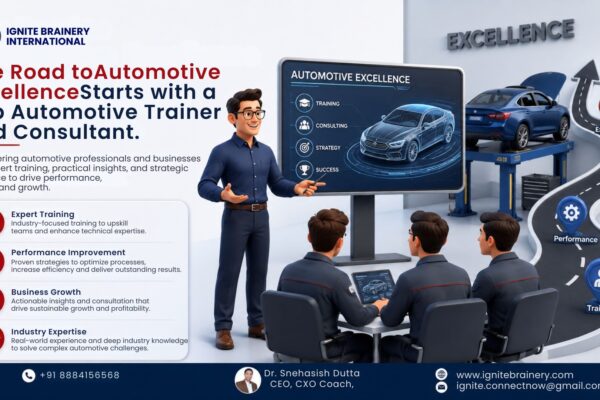
Trainers lock down floor execution by drilling reps on phone control and forcing advisors through proper service write-ups. That fixes rep habits, but those skills stall inside a broken store layout—which is why consultants step in to overhaul desking workflows, retool pay plans, and clear drive bottlenecks so floor effort actually hits the bottom line.
Consultants locate systemic revenue extraction points. They audit compensation plans, desk management workflows, floorplan carrying costs, and service drive capacity constraints. Employing only a trainer inserts competent employees into broken systems. Employing only a consultant generates optimisation blueprints that floor staff cannot execute. Maximum gross profit requires dual integration.
Five Training Areas That Make a Real Difference
Fixing a single department cannot protect total dealership profit. Variable and fixed operations running conflicting workflows actively destroy retained gross margin. Management must force an identical execution standard across every revenue centre to stop the leak.
1. Leadership and Management
High-volume unit production dictates management promotions. Individual sales numbers mask severe leadership deficits. This standard promotional path ignores baseline structural management. Training forces absolute desk accountability. The curriculum dictates rigid pipeline workflows. The desk executes strict F&I handoffs. Store protocols mandate immediate customer turnovers.
Capable managers run shifts entirely on store analytics. Gut instinct at the desk bleeds front-end gross profit. Training replaces subjective floor management with metric-based performance coaching. High-producing sales representatives retain employment. Overall dealership stability metrics improve.
2. Automotive Sales
Contemporary vehicle buyers execute extensive digital research prior to lot arrival. Traditional pressure tactics fail against transparent market data. Modern sales protocols demand structured discovery processes. Trade-in evaluations require absolute transparency. Digital lead handling necessitates immediate, templated response architecture.
Value-based closing techniques replace arbitrary price reductions. Sales personnel learn precise gross profit defence mechanisms. They present rigid option structures. Dealerships retain maximum front-end gross without sacrificing conversion volume.
3. Customer Experience
Buying fresh traffic drains capital. Holding existing buyers protects it. Floor training mandates strict word tracks for every customer touchpoint. Advisors must issue preemptive repair updates when parts stall to prevent drive-offs. The sales desk handles price friction using hard objection scripts to lock in front-end gross.
Sold units enter an automatic CRM callback loop. CSI survey results dictate all OEM bonus money. Securing that exact score builds the repeat buyer pipeline. Total store profit hinges entirely on this mandated retention model.
4. EV and New Technology Awareness
Moving EV and ADAS units demands hard product knowledge. Buyers expect exact battery degradation limits, Level 2 hardware specs, and federal rebate codes. Floor staff must quote these metrics instantly. Stalling on charging data destroys buyer confidence. Hesitation blows the write-up.
Fixed ops mandates hard technical certs. Service bays demand specialised high-voltage clearance for every advisor and tech. EV diagnostics necessitate specialised tooling operations. Failure to maintain these certifications introduces extreme physical liability and halts service drive revenue.
5. Performance and Productivity
Administrative operational drag erodes net profit margins. Productivity training isolates and eliminates redundant procedural steps. Sales floor administrative tasks undergo severe streamlining. Business Development Centre communication logs integrate directly into simplified workflows.
Service drive repair order creation speed increases. Trade-in valuation approval hierarchies flatten. Dealership turnaround times decrease systematically. Total volume capacity expands without necessitating headcount payroll increases.
What Consulting Adds to the Picture
Training upgrades individual human output. Consulting fundamentally reconstructs the governing business environment. Consultants dissect underlying store metrics. They audit third-party vendor agreements. They analyse compensation structures against inventory turnover velocity.
Consultants locate and eradicate systemic bottlenecks. They replace broken workflows with functional operational designs. They establish rigid Key Performance Indicators. Sales and service personnel subsequently execute upgraded skills inside an environment mathematically engineered for transaction speed.
How Ignite Brainery Approaches This
Ignite Brainery merges direct personnel skill development with structural operational consulting. The methodology rejects generic corporate presentations. Interventions require store-specific diagnostic data. The process starts with a severe operational audit. Analysts measure current sales logs, service drive throughput, and exact lead conversion rates.
You should know that the audit really dictates custom curriculum construction. On the other hand, content aligns strictly with the compliance guidance of the franchise. Once done, execution is known to occur on the physical showroom floor. Mentors offer coaching in real time during live retail hours. Post-training accountability mostly depends on continuous metric tracking in order to measure financial returns.
Who Can Benefit
Franchise dealerships implement these frameworks to hit non-negotiable OEM bonus thresholds. Standardising sales floor execution guarantees compliance. Independent auto groups utilise the consulting layer to unify scattered processes. They enforce identical pay plans and inventory management rules across diverse geographical locations.
Commercial fleet operators deploy these systems to compress vehicle downtime. They implement strict maintenance workflows and driver accountability protocols. Independent repair facilities adopt the training to maximise billable hours per repair order. They streamline advisor intake mechanics to retain elite technician talent.
How to Choose the Right Trainer and Consultant
Dealership operators must apply strict evaluation criteria to potential partners. Qualified consultants possess proven retail automotive management histories. Corporate coaches lacking direct dealership operational experience fail. Partners must deliver both systemic consulting and direct personnel training simultaneously. Single-focus manual providers waste capital.
Training methodology must rely entirely on hard telemetry. Providers must track gross profit, absorption rates, and inventory turn velocity. Vague cultural shift promises lack financial utility. Programs require total customisation to local market dynamics. Mandatory post-training metric audits prevent skill degradation.
Building a Team That’s Ready for What’s Next
If there is continuous structural adaptability, long-term retail automotive remains profitable. Inventory supply dynamics shift constantly. Consumer acquisition behaviours evolve rapidly. Powertrain diversification accelerates. Operational survival requires personnel capable of executing immediate strategy pivots.
Fixing desk workflows while drilling floor reps locks in store gross when unit volume drops. Skilled reps cannot hold margin inside a broken desk process, and upgraded software will not close a customer on its own. Surviving a market shift takes tight backend architecture and daily floor discipline working at the same time.
Ready to Get Started?
Dealership operators must review month-to-date performance telemetry immediately. Identify current lead conversion collapse points. Measure exact service advisor turnaround delays. Calculate current front-end and back-end gross profit per unit averages against historical baselines.
Contact Ignite Brainery directly. Schedule a comprehensive operational assessment. Analysts will identify structural revenue leaks. Ignite Brainery will deploy a targeted consulting and training architecture to permanently seal dealership profit loss.
FAQs
Q1. What does a top automotive trainer and consultant do?
An automotive trainer teaches technical, operational and customer-facing skills, while a consultant helps businesses identify gaps and improve their processes. The work may cover areas such as service operations, dealership performance, team development and changing automotive technologies.
Q2. Who needs automotive training?
Automotive training can be useful for technicians, service advisors, sales teams, dealership staff, managers and other professionals working in the sector. Training can be arranged for new employees as well as experienced teams who need to update their skills.
Q3. What is the difference between an automotive trainer and a consultant?
An automotive trainer mainly focuses on building the knowledge and skills of employees through structured learning. An automotive consultant looks at the wider business, identifies operational issues and provides recommendations for improvement. One may focus on people development, while the other may work more closely with business processes and performance.
Q4. Why is EV training important for automotive teams?
Electric vehicles use different systems, components and safety procedures from conventional petrol and diesel vehicles. EV training helps automotive teams understand high-voltage systems, battery technology, diagnostics, maintenance procedures and safe working practices.
Q5. How do I choose the right automotive trainer in India?
Look at the trainer’s automotive experience, technical knowledge, training methods and understanding of the Indian automotive industry. It is also useful to check whether the programme matches your team’s role, business requirements and level of experience.
Q6. Can automotive training programmes be customized?
Yes, automotive training can be adapted to suit the needs of a particular company or team. The content may be adjusted according to job roles, skill levels, technical requirements, dealership processes or specific areas that need improvement.